

CPR Course Australia - HLTAID009
HLTAID009– Provide Cardiopulmonary Resuscitation (CPR)
Key Details for CPR Renewal in Australia
CPR renewal supports safe workplaces and community safety by ensuring people can respond quickly and correctly during a cardiac arrest. While certificates are nationally recognised, most employers and industries expect annual renewal because CPR is a hands-on skill that can decline without practice. Renewal training reinforces correct technique, updates learners on current practice, and improves confidence under pressure.
Course Fee
What You Need to Know
1) Unit of Competency (Nationally Recognised)
- CPR renewal training in Australia is commonly delivered under the nationally recognised unit:
- HLTAID009 – Provide Cardiopulmonary Resuscitation (CPR)
2) Renewal Frequency (How Often You Should Renew)
CPR renewal frequency is often guided by workplace policy, industry expectations, regulators, and insurance requirements. In many industries, CPR is expected to be refreshed every 12 months because it is a high-risk, time-critical skill that relies on correct technique and confidence.
- Common industry expectation: every 12 months (annual CPR refresh)
- Why annual: helps maintain correct compression depth, rate, airway management, and AED confidence
- Best practice: renew early if your certificate is nearing expiry to avoid compliance gaps
Keep Your CPR Skills Current
Check your employer or industry requirements when planning CPR refresher training. Practical assessment is required to demonstrate your skills.
3) Practical Assessment (Mandatory Requirement)
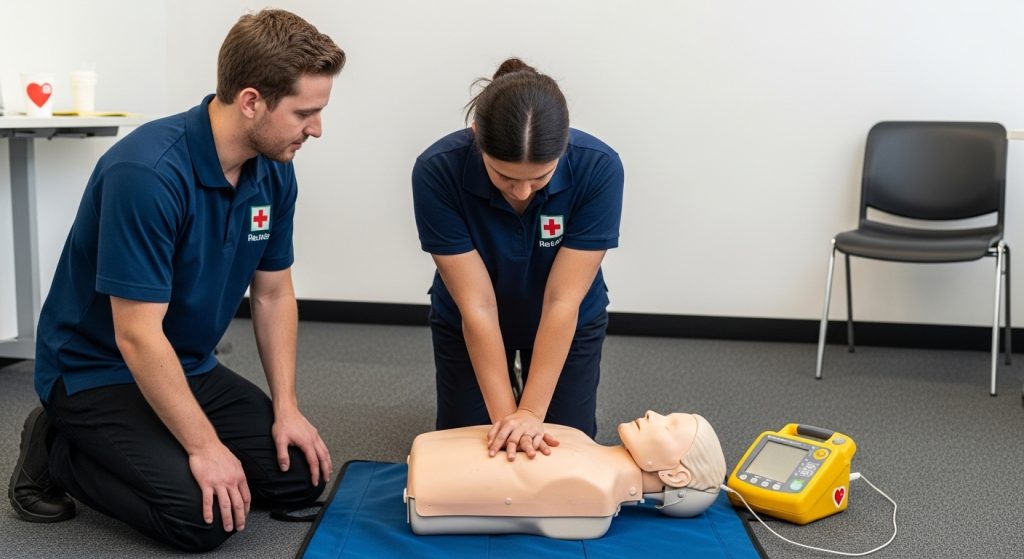
CPR competency requires a practical demonstration of skills. Practical assessment must be conducted in person to confirm the learner can perform CPR correctly and safely in a realistic training environment.
- Adult CPR on a manikin
- Infant CPR on a manikin
- AED use (power on, pad placement, safety checks, follow prompts)
- DRSABCD sequence and hazard control
- Infection control (gloves, hygiene, safe disposal, cleaning)
Important: Online theory may be available, but practical assessment must be face-to-face.
4) Key Knowledge Areas Covered
CPR renewal includes essential knowledge to support safe and effective action:
- Recognising cardiac arrest and abnormal breathing
- Calling emergency services and communicating clearly
- Chain of survival and early defibrillation importance
- Legal and ethical considerations (duty of care, consent where applicable)
- Workplace emergency response procedures
- Managing bystanders and requesting assistance
- Post-incident actions (handover to paramedics, debrief, reporting)
5) CPR Technique Essentials (Quality Matters)
Quality CPR significantly improves the chance of survival. Renewal training reinforces the practical fundamentals:
- Correct hand position and compression posture
- Consistent compression rate and depth
- Allowing full chest recoil between compressions
- Minimising interruptions and maintaining rhythm
- Safe delivery of rescue breaths (where applicable) and airway management
- Team CPR and smooth changeovers to reduce fatigue
Learners practice with trainer feedback to correct common errors and build confidence.
6) Delivery Options (How CPR Renewal Can Be Delivered)
CPR renewal may be delivered through flexible modes while still meeting competency requirements:
- Blended learning: online theory + face-to-face practical assessment
- Classroom training: trainer-led learning and practical skills
- On-site workplace training: suitable for teams and group bookings
Training must be delivered and assessed by appropriately qualified trainers under an RTO framework.
7) Who Commonly Needs CPR Renewal
CPR renewal is commonly required or strongly recommended for people working in:
- Security and crowd control
- Hospitality and licensed venues
- Healthcare, aged care, and disability support
- Childcare, schools, and education settings
- Construction, warehousing, and high-risk workplaces
- Fitness, sport, recreation, and aquatic environments
- Workplace First Aid Officers, supervisors, and managers
Note: Some workplaces require CPR renewal annually even when other first aid units remain valid longer.
8) Certification Issued (What You Receive)
After successful completion, participants typically receive:
- Statement of Attainment for HLTAID009
- Nationally recognised certification (Australia-wide)
- Evidence suitable for employer records, audits, and compliance checks
Always keep a copy of your certificate for workplace compliance and renew before expiry where required.
9) Workplace and Legal Responsibilities (Why It Matters)
CPR renewal supports duty of care and workplace safety by ensuring staff remain capable to respond in emergencies. Employers and workers should ensure:
- CPR certification is current and recorded
- Training aligns with role requirements, workplace policy, and emergency plans
- Refresher training is scheduled to avoid expired credentials
- Incident reporting and emergency procedures are understood
Maintaining current CPR skills can also support workplace insurance expectations and audit requirements.
10) CPR Renewal + First Aid (How They Work Together)
CPR renewal is often completed on its own, or as part of a broader first aid pathway:
- HLTAID009 – CPR (commonly renewed annually)
Many workplaces expect CPR to be refreshed yearly even when full first aid certification is current, because CPR competence is crucial in the first minutes of an emergency.
At a Glance
Online theory and face-to-face practical assessment are mandatory.